Desktop App · 2026
Quiro native screen studio
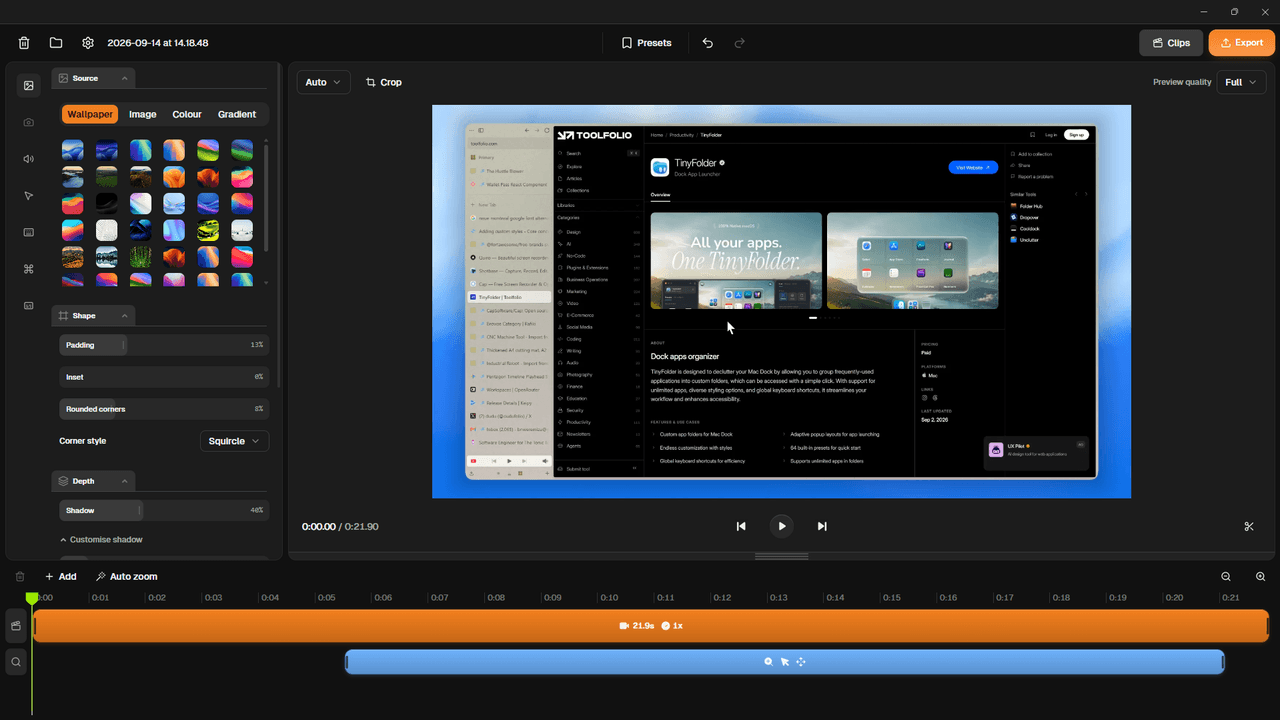
Quiro is a native screen recorder and editor for Windows, macOS, and Linux: screen, camera, microphone, and system audio captured together, then zooms, backgrounds, captions, and annotations composed locally and exported as a file you own. No account, no upload step.
- Tauri
- Rust
- React
- TypeScript
- wgpu
- FFmpeg
- Next.js
- Cloudflare R2
Problem
Making a polished product demo usually means paying for a subscription tool or paying a video editor, and most of those tools want your recordings in their cloud. I wanted a recorder that does a video editor's framing work for you: intentional zoom, cursor emphasis, clean composition, while every recording stays a plain file on your own machine.
Challenge
Annotations were second-class citizens. The editor drew them twice: as SVG on screen and as Canvas2D when exporting a screenshot, and the Rust video renderer didn't know they existed, so an arrow or a text callout could never appear in an exported video. There were even two parallel systems for the same idea: timed, GPU-drawn text and mask segments on the timeline, and untimed, pixel-space annotations in the canvas. I unified them into one model with real timing, normalized coordinates, and anchors, moved shapes, arrows, text, masks, and focus effects into the native wgpu renderer, and made export a single native pass. The on-screen SVG layer now only draws selection chrome, so what you see in the editor and what lands in the file come from the same renderer.
Architecture
A Tauri v2 shell with a React and TypeScript editor UI over a Rust workspace of around forty crates. Capture is native per platform: Windows Graphics Capture through Direct3D, ScreenCaptureKit on macOS, and X11 (XComposite per-window capture) or Wayland on Linux, alongside dedicated camera crates for Media Foundation, DirectShow, and AVFoundation. A wgpu renderer composites backgrounds, padding, shadows, perspective, zoom, and annotations, and encoding runs through FFmpeg plus the hardware encoders each OS provides. Rust types are exported to TypeScript with specta, so the UI and the engine can't drift apart. The marketing site at quiro.app is Next.js, and releases ship through a Cloudflare R2 bucket that feeds a signed auto-updater.
Decisions
- Rebuilt on top of the open-source Cap project's Rust capture and encoding stack instead of writing native capture from scratch a second time. The first version of Quiro was Electron with hand-written C++ and Swift capture helpers; forking a proven core let the effort go into the editor instead.
- One renderer for everything: annotations, masks, and text moved into the native wgpu pipeline, so preview and export can't disagree.
- Release files are immutable, versioned folders cached forever, while only the small updater and download manifests are served uncached, so a new release reaches every installed copy within minutes without ever invalidating an installer.
- Crash and camera diagnostics through PostHog report the failure stage, OS, app version, and hardware vendor/product IDs, but never device serial numbers.
- Linux went from a generic fallback to a first-class download and auto-update target, with real per-window capture on X11 and output enumeration on Wayland.
What went wrong
Forking a large, mature codebase means inheriting what you don't understand yet. The out-of-process muxer binary was dropped during the fork and had to be ported back after the fact. macOS builds were briefly reported by Gatekeeper as "damaged" for anyone who downloaded them, which I fixed with ad-hoc signing; full Apple notarization is still outstanding. And the AI editing agent from the Electron version didn't survive the rebuild; it's not in the current app.
Lessons
Knowing when not to write something yourself is an engineering skill. Building capture by hand the first time taught me how it works, and that's exactly what made it possible to read, trust, and extend someone else's far more complete version. The annotation work taught the other half: the real fracture is usually one layer below where it feels like it is: the canvas wasn't the problem, the annotation model was.